Wednesday, February 08, 2006

Let's make macarons

First of all, I think something needs to be said about my long absence from this blog. I guess I just lost the motivation to write. Surprisingly, two days of school generated such copious amounts of notes to be typed up that it usually takes me two or three days to put them all in order. After that, who has the will to type anything else!

So what brought me out of “retirement”? Macarons! Yes, ever since I had my first taste of real Parisian macarons at Laduree, I have been obsessed. But it’s not easy to find macarons of the perfect texture. Since they’ve become somewhat of a trend in Tokyo recently, you can’t walk through a depa-chika (department store basement food section) without coming fact to face with a couple of macaron showcases. Some are pretty good, but some are downright horrible. The perfect macaron, in my humble opinion, should have a crunchy and dry surface with a slightly moist center. When you bite into one, the surface should crackle and crumble, before collapsing into the marzipan filling. At any rate, that’s the golden macaron standard I adhere to.


As much as I love macarons, however, I never tried to make it myself, because I know they are extremely temperamental little fellows and will not just puff up perfectly for just anybody. This fact changed, however, when I had to make them at Le Cordon Bleu. The three batches I made in class, although not perfect, were good enough to give me the confidence to try more. My bubbles were soon busted though as the first two home-baked batches cracked and spread out like a flat disc and had the texture of sticky gum. The key thing missing, I figured, was the powerful Electrolux oven we used in school. But how do I find a way to circumvent that? Time for some research. I hit the bookstores and read every recipe I could find on macarons, got some ideas and hit the kitchen again. The third and fourth batches turned out better but it wasn’t until the fifth batch that I was finally somewhat satisfied with the results.

Without further ado, I present to you a working recipe that I will probably continue to tweak further every time I make it, until perfection is finally achieved.

Basic macaron recipe:
60g almond powder
110g confectioner’s sugar
50g egg white
3g dry egg white
15g granule sugar

1. Sift together confectioner’s sugar and almond powder
2. Place egg white in a large bowl and break up the thick parts with whisk
3. Add dry egg white and beat with whisk (dry egg white absorbs moisture from egg white and makes meringue firm)
4. Add the granule sugar in two portions and beat into soft peaked meringue
5. Add half of the sifted sugar and almond powder into bowl, fold with spatula gently. If adding food dye, add with the first addition of dry ingredients.
6. Add the other half and fold (this is called macoronage). Stop mixing when batter becomes shiny. Do not over-mix.
7. Immediately fill pastry bag fitted with 11mm round tip and pipe onto baking sheet lined with silpat into rounds.
8. Leave macarons out to dry for about 30minutes, until it doesn’t stick to your finger when touched. Preheat oven to 350C.
9. When surface of macarons are sufficiently dry, place inside the oven to bake. After about five minutes, the “ruffled skirt” should develop around the bottom edge of each macaron. Rotate the baking sheet 180 degrees, and bake for another five to 7 minutes.
10. Check to see if macarons are done by grabbing the top of one macaron and try to shake it. It’s done if the top barely slides against the “ruffled skirt”. If it’s not done, extend baking time by two minutes intervals and checking after each extension.
11. Move silpat to a cooling rack. After macarons have cooled to touch, remove them from silpat and place upside down on rack. Place inside fridge to cool.
12. Sandwich with desired filling when macarons are cooled, and store in a tightly sealed container at room temperature.
Macarons taste the best the next day, after they’ve had a chance to dry out further.

Notes:
1. The first step to successful macarons is the consistency of the meringue. If using stand-mixer, watch carefully and not let the meringue get too stiff, or it will become hard to incorporate the dry ingredients, which will lead to over-mixing.
2. It takes practice to know when to stop “macoronage”. If batter is over-mixed, macarons will have a very smooth and shiny surface but will not rise in the oven. If not mixed enough, surface will crack while baking. Within the acceptable range, you can adjust the degree of macaronage to achieve the right balance between smooth surface and airy texture.
3. If you have a good convection oven with circulating hot air, you may be able to reduce oven temperature to 150C/300F, as long as macarons are baked in about 12 minutes. If macarons don’t rise within the first five minutes, increase oven temperature.
4. If you have to take the macarons out of the oven before they are completely baked because they have started to brown, you may dry them out by leaving them in the fridge uncovered, bottom side up.
5. If on the other hand, you’ve over-baked them and the bottom is too dry, leave in the freezer so they soak up moisture (make sure there’s no smell in your freezer).

Final word of caution:
This recipe is developed to suit my big old GE gas oven, with the room humidity between 55-65% and room temperature around 22C. It will almost certainly need adjustment to suit your oven and climate. If it doesn’t work the first time, don’t give up! Remember, fifth time was the charm for me.

Wednesday, November 09, 2005

Pierre Herme – Azure

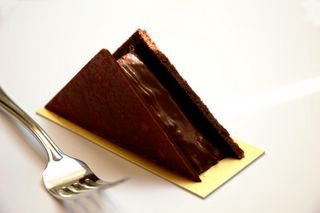
Ever since I started Le Cordon Bleu a month and a half ago, I had almost no chance to eat any dessert other than the ones made by me. On top of the large quantities of things I churn out at school every Thursday and Friday, I also get the itch to make something of my own once in a while. As a result, Jason’s colleagues and our friends and neighbors have been having desserts pushed on them on an almost daily basis. Needless to day, this put a severe damper on my quest to taste test every Pierre Herme dessert on sale in Japan. But I did find a rare gap where there was no dessert at home and I took the opportunity to taste one of PH’s classic items, the Azure.


The azure contains two of my all-time favorite flavors: chocolate and yuzu. In fact I’ve had my eyes on it from the beginning but somehow have always bypassed it, probably because it looks plain compared to PH’s other creations and did not contain any exotic flavors such as cilantro or saffron. However, I was in the mood for something simple and uncomplicated that day and Azure fitted my needs exactly. It is a layer of chocolate ganache and a layer of yuzu cream, sandwiched between a piece of dark chocolate and a piece of chocolate sablee cookie. No fancy decorations or unexpected surprises. It’s simplicity at its best. It might even be my favorite so far.

For other Piere Herme items, see here.

Tuesday, November 01, 2005

Why can’t life always be peachy and perfect?

Ok, to be fair, my life is not too shabby. We’ve got our health, Libby’s still going strong at age seven, and we are happy with the way things are for the most part. So I shouldn’t complain, right? But it's my blog, so I am going to anyway, damn it!

It all started three weeks ago when we went to Hong Kong for the weekend to see some friends. Since we only had two days and have exhausted most of the tourist attractions on a prior visit, we focused our attention on food. After the first day I started to break out in hives, little bumps like mosquito bites here and there, nothing major. I figured it must’ve been the fengshui or something I ate that didn’t agree with me. I expected the problem to go away when I got back to Tokyo. It didn’t, and in fact got even worse. My stash of Claritin only relieved the symptoms when I took it but never made the problem go away. The problems with western medicine!

So frustrated by the ever present itchiness somewhere on my body, I almost gave in to Jason’s constant nagging and went to see a doctor. Luckily though, I talked to my parents, two veteran allergy sufferers, first. Their theory, and mine, is that some allergies come from within, caused by a toxin inside the body that somehow got triggered by an outside factor. According to them, to make it go away, I have to stop eating any food that could be allergy-triggering or are “heating.”

We Chinese believe that certain food will “bring on” diseases, or in other words, make the body susceptible to illnesses. We say they are “fah.” We also divide food in three general categories: cooling, heating and neutral. I am somewhat familiar with the heating and cooling properties of food but am completely clueless when it comes to which food brings on illnesses. So I asked my mom to give me some examples of food that’s “fah.” “Well, cilantro is a big one,” she said matter-of-factly.

Wait! Woah! Hold on a minute! Cilantro??!! Fragrant, green, healthy-looking cilantro? I just bought a big bunch and in a race against time to prevent it from rotting away in my fridge have been putting it in everything. I even made ice cream with it. No wonder my allergy is not getting any better!

After I calmed down she told me more. Seafood is no good, although fresh water fish is benign. (not helpful because there ain’t no fresh water fish sold in Japan, except for that very seasonal ayu) Spicy food of any kind is bad (I found fresh jalapeno pepper for the first time in Tokyo and had been eating nothing but spicy food lately). Chicken, and especially turkey should not be eaten either, and it’s best not to touch beef or cheese. Hmmm, I think that’s about 80% of my daily diet right there. Add to it the “heating” food such as oranges and anything red in color, I’ll have to eat nothing but rice and green vegetables until my allergy clears up! And no turkey? What about Thanksgiving?!

“So, um, is there anything left for me to eat at all?” I asked. “You can always eat pork and duck!” mom offered enthusiastically. Sure, that helps! The only way I know how to cook a duck is to roast it, and what’s that going to do to my waistline if I make it a daily item on the menu?

Arrrrgh! This is all so irritating. I guess with a mom that’s allergic to just about everything she touches and a dad whose pollen allergy is so severe that he used to schedule his overseas trips to coincide with the peak of allergy seasons, it’s a small wonder that my allergy problems didn’t manifest until now. Still! Why can’t I eat everything I want and be happy?!

Monday, October 31, 2005

Judging for DMBLGIT

As some of you know, I won the “Edibility” category of the ninth “Does My Blog Look Good In This” photography contest last month. Through my win I found a friend in Chubby Hubby, a blogger from Singapore, and a fellow flickrist. I was an instant fan of his aesthetically pleasing and creative food photographs. So when he told me that he was hosting the tenth DMBLGIT contest and asked me to be a judge, I gladly accepted.

There are a total of 45 entries and picking out five top winners for each of the three categories (aesthetics, edibility, and originality) proved to be a difficult task. One photo did stand out in particular and I hope the other four judges will agree with me and give it high marks.

Well, keep an eye on the Chubby Hubby blog for winner announcement and let the best photo win!

Tuesday, October 25, 2005

Keep It Simple

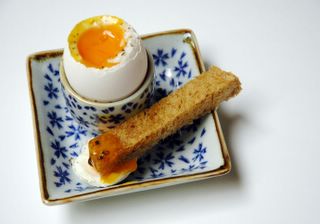
A couple of months ago when we went to London, our friends whom we stayed with served us a typical French breakfast on their roof top terrace over looking the Tower Bridge. The first item on the menu was buttered toast dipped in soft-boiled eggs. Maybe it was the fabulous view, or maybe it was the crisp morning air, gooey egg yolks never tasted so good.

Last weekend, we found ourselves stuck at home because of a typhoon that was sweeping through Japan. Jason was surfing the net while flipping through a GQ magazine, and I was reading a book that had to be returned to the library soon. Suddenly he turned to me pointing at a page in the GQ in his hand, “Can we have this for lunch?” And it was the same soft-boiled egg and toast. Having just had a rather filling breakfast, this light fare seems the perfect solution. Plus the sauerkraut bread that I made during the week is turning hard and would be perfect for toast.

Ten minutes later we had ourselves a simple but sumptuous lunch of egg and toast. Who said one has to labor for hours in the kitchen to have a decent meal? Sometimes all you need is ten minutes (of course I’m not counting the hours spent making the sauerkraut bread).


Monday, October 17, 2005

The Scent of Autumn

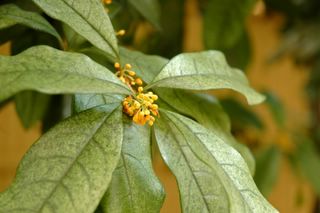
Does anyone know the English name for this flower? It’s called “gui hua” (桂花) in Chinese and “kin no mokusei” (金の木犀) in Japanese, but what’s it in English?


I was pleasantly surprised my first autumn in Japan when I woke up one morning to a distantly familiar sweet fragrance that I hadn’t smelled since I was a kid in China. It wasn’t until then that I realized that all the trees in the yard were “gui hua” trees! Later when we moved out of that house, one of the things I didn’t want to let go of was those trees, them and my humongous kitchen that took up half the first floor. But that’s a subject for another time.

You know the saying about closing windows and opening doors (or is it the other way around)? I was thrilled to find out one of the trees in my current yard is a “gui hua” tree came autumn in our new apartment.

So what is the big deal about those trees besides the fact that they smell nice? First of all, you don’t know how lovely the fragrance is unless you’ve experienced first hand. It’s not as strong as rose or as sweet as gardenia. If I have to come up with a comparison, I would say it’s like the honeysuckle in that elusive almost-not-there quality, yet it sneaks up on you when you are not paying attention and shocks you with a freshness unknown to any other flowers. Secondly, it’s not just good for its smell. You can eat it. Here is how.

When the flowers are starting to bloom (they only lasts for about a week) pick the ones that had just opened (fully opened ones are not as flavorful). Do not wash, as that the fragrance will be washed off, and place in a small saucepan. Put in sugar and water in a 2:1 ratio and bring to a boil. Boil until syrup thickens and flower turns a dark golden color. Pour into a clean glass jar. This is your “gui hua” syrup. You can add it to any Chinese dessert such as almond tofu, glutinous rice balls or sweet eight-treasure porridge “八宝粥”. Or if you are ambitious, you can make gui hua flavored steamed lotus roots stuffed with glutinous rice, “桂花糖藕”, which I plan to try in the near future.

Tuesday, October 04, 2005

My Blog is One Year Old

I had some free time today so I thought I'd organize my blog entries into categories, and what do you know? I found out that I wrote my very first blog entry exactly one year ago to the day!

Two hours of hard labor later, I now have manually categorized every single blog entry I wrote in the past year. Now if you would turn your attention to the side bar, you'll find something called "Let There Be Order" - my low tech solution to blogger's lack of automatic sorting function.
.

First Week at Le Cordon Bleu

Three people cut their fingers; one person never showed up; one girl lost her wedding ring (later found); another thought she’d lost her mind when she couldn’t find her things in the locker after class (she used the wrong locker and the rightful owner of the locker turned her things in to the administrator); many people locked themselves out of their own lockers (myself included, twice. LCB has a really stupid locker system). Yup, that about sums up my first practical session at Le Cordon Bleu. Eventful, huh!

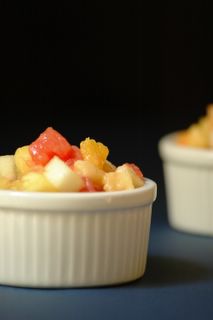
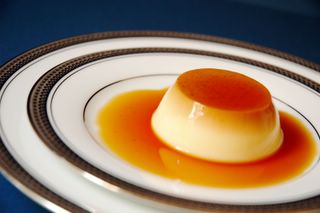
So what did we make? Fruit salad (to practice cutting fruits the correct way) and Flan au Caramel (aka pudding).


The first lesson wasn’t too bad because the subjects were relatively simple. Besides the salad and pudding, the teacher also demonstrated how to make crème brulee. The fruit salad was really nice due in large part to the quarter of a vanilla bean that was thrown into the mixture. The pudding was the creamiest and most flavorful I’ve ever had. Granted, I don’t usually order the humble flan au caramel in restaurants so I only have the convenient store variety as a yardstick, but I’m still pretty sure it was good. I have mixed feelings about the crème brulee, however. On the one hand, the full-on vanilla flavor was heavenly (can you see the vanilla seeds swimming on top?); but on the other hand, I felt that the texture was not as creamy as the one I made the more scientific way. (LCB does not believe in giving baking time so everything is done by eye-balling, without even a timer! I find this very hard to get used to.)

I hate to sound like a wimp but I was EXHAUSTED after a full day of class (3 hours practical plus 3 hours lecture). Interestingly it wasn’t the practical session that tired me out, it was all that Japanese thrown at me during lecture that gave me a huge headache. It felt exactly like the first week at work: brain overload. The problem is that I have to listen to the lecture in Japanese and take notes in English at the same time. Maybe I will go for the test for simultaneous interpretation after I’m done with LCB, but for now it’s taking every bit of energy and concentration I have in me. It’s still fun though, and I can’t wait till my next practical, where we make classic apple tart. It’s a beauty to behold. I hope mine turns out pretty.