Showing posts with label Chinese. Show all posts

Thursday, February 21, 2008

Have you Lo-hei’d this year?

Last Saturday, we went with Lynettte and a group of friends to the lovely Sichuan Do Hua restaurant for a Chinese New Year celebration dinner. But, wasn’t CNY last week? Yes, and no, because traditionally CNY is celebrated for fifteen whole days, ending with the lantern festival on the fifteenth day. So we were well within the celebratory period.

Lynette had outdone herself by booking the most beautiful private room in the restaurant and before we even finished wooing and aaahing, two waiters served us tea kung-fu style. Now that’s service with panache!

One must-have Chinese New Year dish in Singapore is Yu Sheng, which means raw fish literally. It is actually a salad with sashimi and various other ingredients, all carrying auspicious meanings. The way to eat it is called Lo Hei, which is Cantonese for “lifting up.” The restaurants usually prepare long chopsticks (about a foot long) so everybody can stand up around the table and use the chopsticks to toss, or throw the salad in the air, depending on how you look at it. Some say that the higher you toss, the more luck and prosperity the new year will bring. Even though we have lived in Singapore before I had never taken part in Lo Hei or eating Yu Sheng until then. In fact, only a handful of people in our group have had it before so the novelty factor caused us all to giggle like little kids while enthusiastically scattering salad greens and precious abalones all over the table. We only stopped when someone pointed out that if we carried on like that there’d be nothing to eat.
According to our Yu Sheng expert (a Singaporean and two Italians who have eaten it before), Si Chuan Do Hua’s version is a little different. They included abalone and a crispy fish skin, and also used a very nice plume sauce for the dressing. I loved it so much I had two heaping servings and would’ve had more if there was any left.
Besides the Yu Sheng we also had the following dishes: eight treasure seafood soup sans sharks fin, steamed red grouper, braised prawn in spinach sauce, DongPo pork, scallops in potato basket, fried noodles, and a dessert of longan and red date soup.

Everything was delicious, although I was puzzled as to why there weren’t any spicy dishes since the chef is from Si Chuan, home of Ma Po tofu, until Lynette reminded us that she was the one who picked the menu, hee!


At the end of the dinner we were served fortune cookies! I was tickled to see those because I didn’t think anyone else used them except Chinese restaurants in the US. When I opened my cookie, I found a fortune that said I had won a $50 dining voucher. But the best part was, I had two fortunes in the cookie, which means I won two vouchers. Now if that’s not an auspicious sign for the new year, I don’t know what is.

Wednesday, June 06, 2007

BBBB, aka, Beer Braised Beef Brisket

When I saw the one off event Cook and Eat Meat hosted by Home Mades to raise awareness of iron deficient anemia, and to get more women to eat meat, I thought, why not? I haven’t been anemic since adolescence, but I’m a woman, and I do crave a big hunk of nicely cooked meat once in a while. Although I enjoy a nicely grilled medium-rare wagyu steak, I usually leave Jason to order that and take a few slices from his plate. Don’t get me wrong, I normally like dishes where you can actually taste the food, and nothing epitomize this better than a well executed steak, but somehow when I think of meat, more hearty dishes such as cassoulet, braised pig trotters, oxtail soup and beef briskets come to mind. I could almost never pass them up whenever they’re on the menu, especially beef briskets, be it a steamy bowl of beef brisket noodles or a beef brisket clay pot. I like the gelatinous tendons cooked to soft, melt in your mouth perfection, and the multitude of flavors soaked up in the meat.

While I was in Shanghai recently I stumbled upon a food magazine called Betty’s Kitchen. It is just a normal glossy filled with recipes and cooking tips, but the magazine also runs a website which updates regularly with more recipes and feedbacks from readers. When I finally got around to type in the url, the first page that popped up contained a beef brisket recipe cooked in beer. I’ve always stayed away from Chinese dishes with complex flavors because the recipes never really tell you how much of the ingredients to add, but Betty’s recipe was very detailed and contained none of the cryptic descriptions so common to Chinese recipes. The addition of beer to the cooking stock also piqued my interest, for I really enjoy the taste of alcohol in my food.

Chinese braised meat dishes usually involve hours of slow simmering and watching the pot to make sure it doesn’t boil over. I usually circumvent this by using my slow cooker, but now that we’ve moved to Singapore where the voltage is 220V, my Cuisinart 110-volt slow cooker had been put into storage. Not wanting to be tied to the stove for half a day I decided use my Le Creuset dutch oven. I did the prep work before noon, place it everything in the Le Creuset and brought it to a simmer. I then slid everything in the oven set to 80 degrees Celsius. At this temperature, the stock is barely bubbling, just below the boiling point, and it’s heated from all the directions, much like a slow cooker. Cooking it this way allowed me to go out for lunch and tea with friends and come home to a kitchen smelling of wonderful braised beef brisket, just in time for dinner.

That night we ate the beef with a bowl of white rice and some roasted baby carrots. The next day, I boiled some eggs, cut a few slits into the surface and cooked them in the meat stock until the eggs turned brown. We then had beef brisket noodle soup with the eggs. The flavors were so robust and multifaceted that it was quite possibly the best beef brisket I’ve ever had.

Here is the recipe with some modifications: (I increased the amount of rock sugar because I like some sweetness in my braised meat)

1.2kg Beef brisket
8 dried red chili pepper
80g ginger, minced
3 carrots, roughly chopped
15 white button mushrooms
10 cloves garlic
3 whole star anise
3 bay leaves
15 whole Sichuan peppercorn
1 tsp anise seed
3 tbsp rock sugar
250ml light soy sauce (Sheng Chou)
18 oz beer
1 tbsp vegetable oil

1. Cut brisket into large pieces
2. Heat vegetable oil over medium heat. Add rock sugar and stir fry until golden
3. Add Sichuan peppercorn, chili pepper, ginger and garlic
4. Turn heat on high, add beef brisket and stir fry until most of the liquid is gone
5. Add beer and the same amount of warm water. Bring to a boil and skim top
6. Add light soy sauce, star anise, bay leaves, and anis seed. Bring to a boil
7. Cover and simmer for 2.5 hours, until meat is tender
8. Add carrots and mushrooms. Cover and simmer for another half an hour

Wednesday, February 02, 2005

Chive Pao - 韭菜包子


Didn't I say I was going to be less wasteful about food this year? You didn't believe me? Here's proof. I used the leftover stuffing for the chive boxes and made them into Chive Pao for lunch. Yes, I did, even though I had no idea how to make the dough for Pao. All I knew was you need to put some yeast into the dough, so I did (one teaspoon to one cup of flour), and let it rise for about an hour before shaping them into Paos. No idea how to steam them either, so I randomly picked 15 minutes and prayed for good results.

I'm not completely satisfied with the dough though. As you can probably tell, it's not as fluffy as the ones you buy in stores and the surface is not very smooth. Jason, on the other hand, had no problem with the dough but reiterated his objection to the vermicelli. Ok! I get the point!

Saturday, January 29, 2005

Chive Box - 韭菜盒子


Chinese chive holds a special power over me: it makes me want to cook Chinese food. The last time I cooked Chinese, which was months ago, was also because of some chives that I bought.

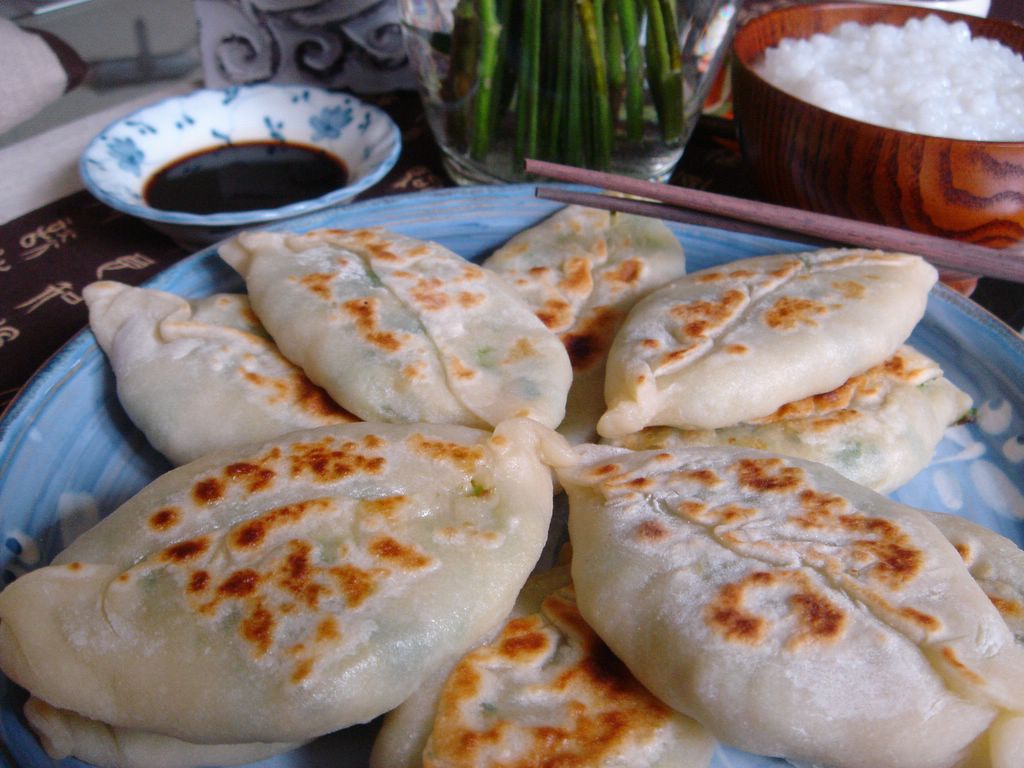
This time, I bought the chives and immediately thought of Chive Box, a pancake with a stuffing of chives and ground pork. I have not had this in years, and I have no idea why it's called a box, since the finished product looks nothing like a box. I do remember, however, that special fragrance that chive and pork produces together.

I am not sure how the dough should be for chive box, so I resort to my scallion pancake dough. Three cups of flour plus about 200ml of boiling water. You could use cold water, but the boiling water makes the dough soft, which is what you want. After forming the dough, let it rest covered for at least half an hour. This relaxes the dough and makes it easier to roll out.

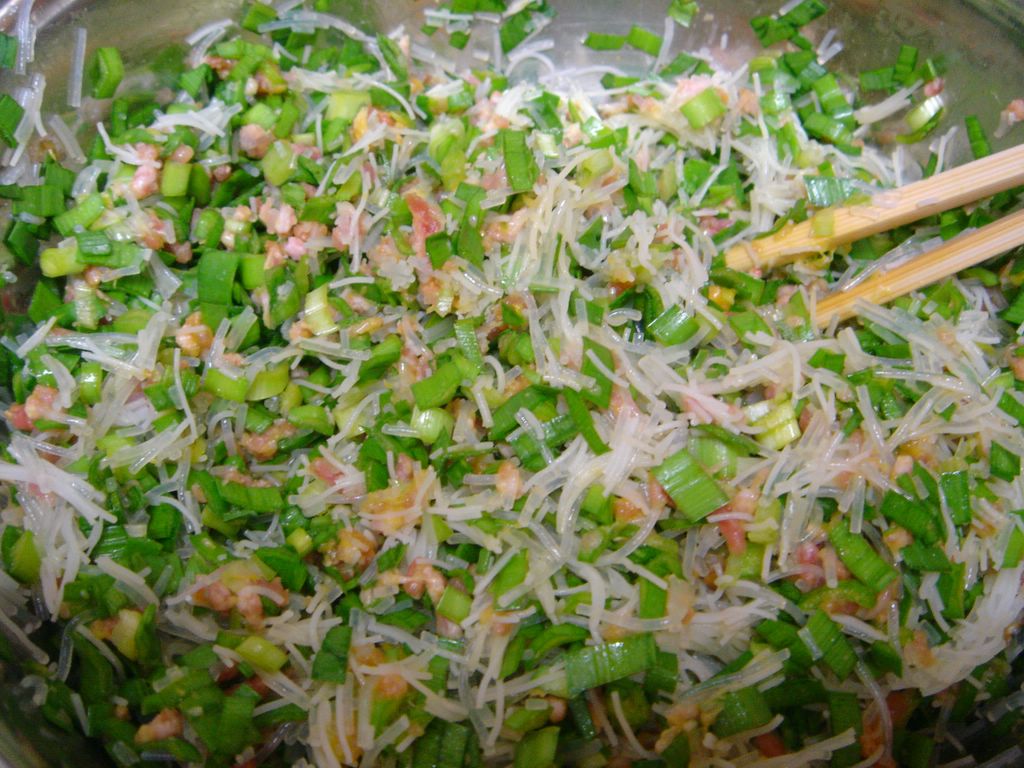
While the dough is resting, you can prepare the stuffing:
Two bunches of Chinese chives (200g total)
One piece of ginger, ground (to taste, about 1 to 2 tbsp)
Ground pork 180g (which is the package size at my supermarket, you can adjust the amount)
Chinese vermicelli 1 pkg (I'm guessing it's around 50g)


First you chop the chives really fine. This should not be done in a food processor because that will cause the chive to bleed out too much liquid. Next mix the ginger and ground pork, and combine with the chives. Meanwhile, boil a big bowl of water to soak the vermicelli until it's soft. Drain out all the liquid, and cut into small pieces. Mix the pork, chives, and vermicelli all together. I had two egg yolks left from making cookies, so I threw them in as well, to make the stuffing stick together.


Heat 2 tsp oil in a pan, add stuffing, season with 2 tsp salt, dump in some white pepper (I use a lot because I love it), and cook for about 3 minutes, until meat is almost done. Sprinkle 1 tsp of sesame oil on top after removing from heat.

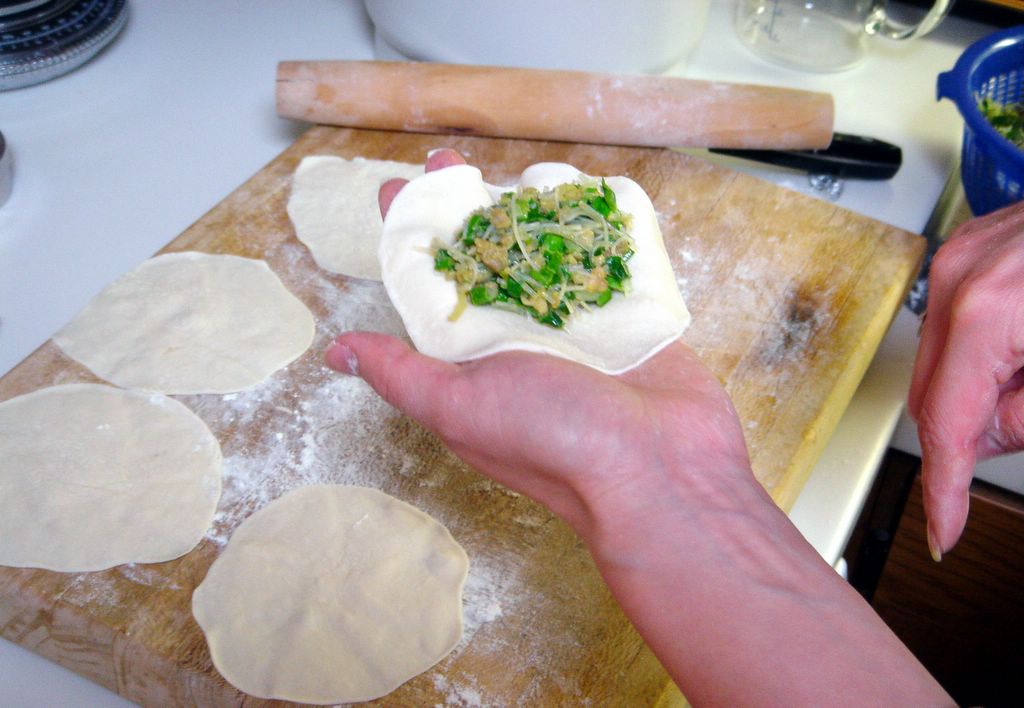
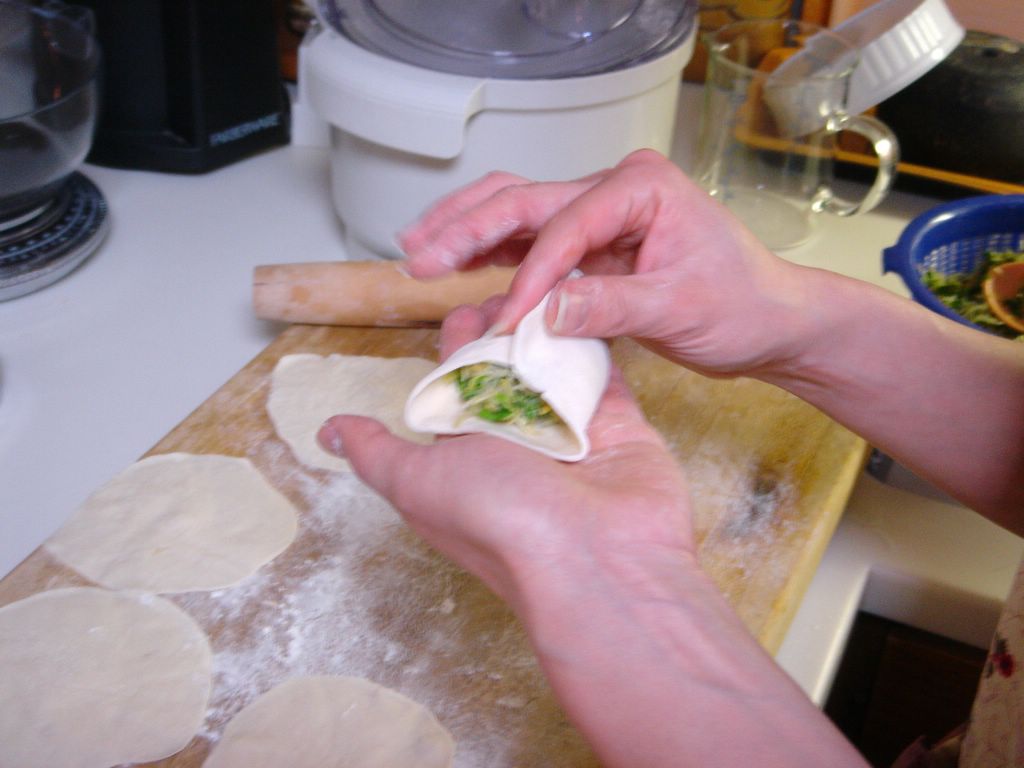
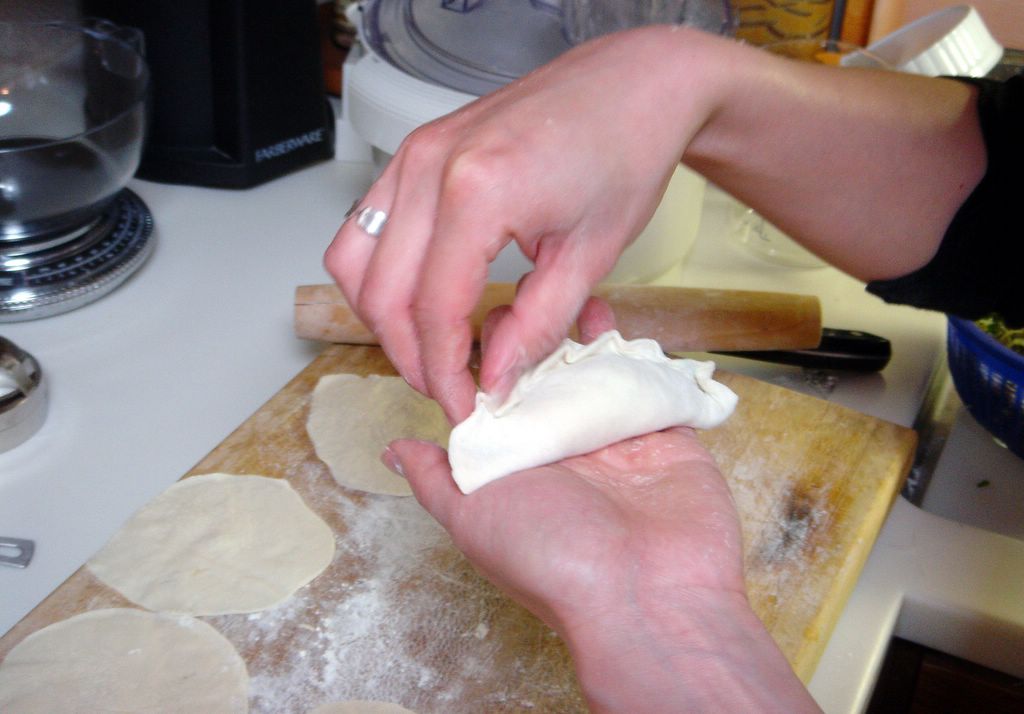
The dough should be ready by now. Divide dough into quarters, working with one quarter at a time, covering the rest to prevent drying. Roll one quarter of the dough into a rope, and divide into five equal parts. Roll each part into a ball and roll each ball into a round about 4 inch in diameter. Place 2 tbsp of stuffing onto dough, and seal by folding it into a semicircle and pinching the sides together, then again folding the seal over itself (third pix below, don't worry if you don't know how to do this). Next, stand it up and flatten with the palm of your hand.


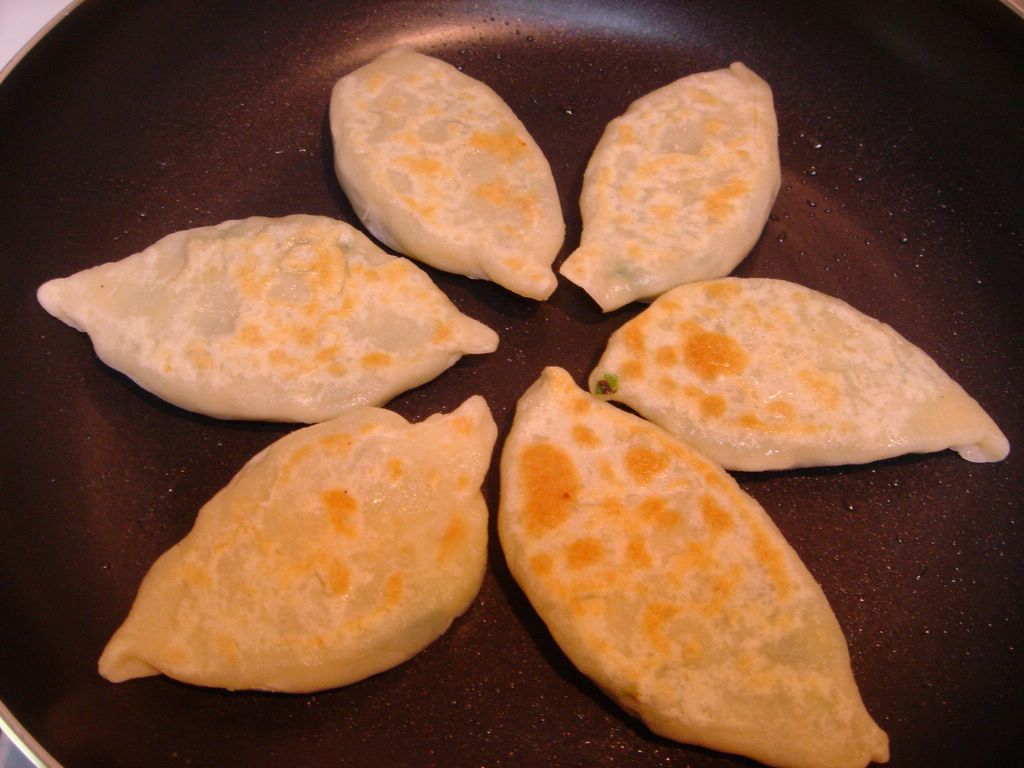
Do this until all the dough is gone, now you have twenty boxes and are ready to cook them. Heat a pan with 1 tsp of oil (best if you have a cast iron pan)until pan is very hot. Place the boxes in the pan and fry 2-3 minutes per side, until golden.


We had the chive boxes with some plain rice porridge for lunch. Since I am a big fan of Chinese black vinegar (香醋), I used it as a dipping sauce. But the Chive Boxes taste just as nice without the vinegar, so you don't have to dip it in anything. Just a thought, if you don't dip it in vinegar, you might need to increase the salt you add to the stuffing, so it's not too bland.

I thought it was pretty good as a first attempt but Jason did not care too much for the vermicelli in the stuffing, saying it makes the textue weird. The man is hard to please! But I think I will leave out the vermicelli if I ever make it again. Not because Jason said so, mind you, but because a) I included the vermicelli to use it up and have no more left, and b)I ended up with some extra stuffing, so minus vermicelli should just be the perfect amount.

Note on storage: since I don't think it reheats well, I only cooked half of the boxes and froze the rest for a quick lunch some other time. I think they can be fried right out of the freezer.

Happy box-making!

Sunday, October 24, 2004

Chinese, anyone?

The problem with Chinese cooking is that there are just no clear-cut recipes out there. Open up any Chinese language cookbook and you see under the ingredient section phrases such as “a little bit of salt”, “the appropriate amount of cooking wine” etc. How am I to know how much is “a little bit” and exactly what is “the appropriate amount”?!! If you are like me, who’s never had to cook while living at home, hence missing out on the opportunity to learn from your parents, you are doomed. And that is exactly why my entire repertoire of Chinese dishes is made up mainly of stir-fried green vegetables, the only dish my dad hand-taught me when I was little.

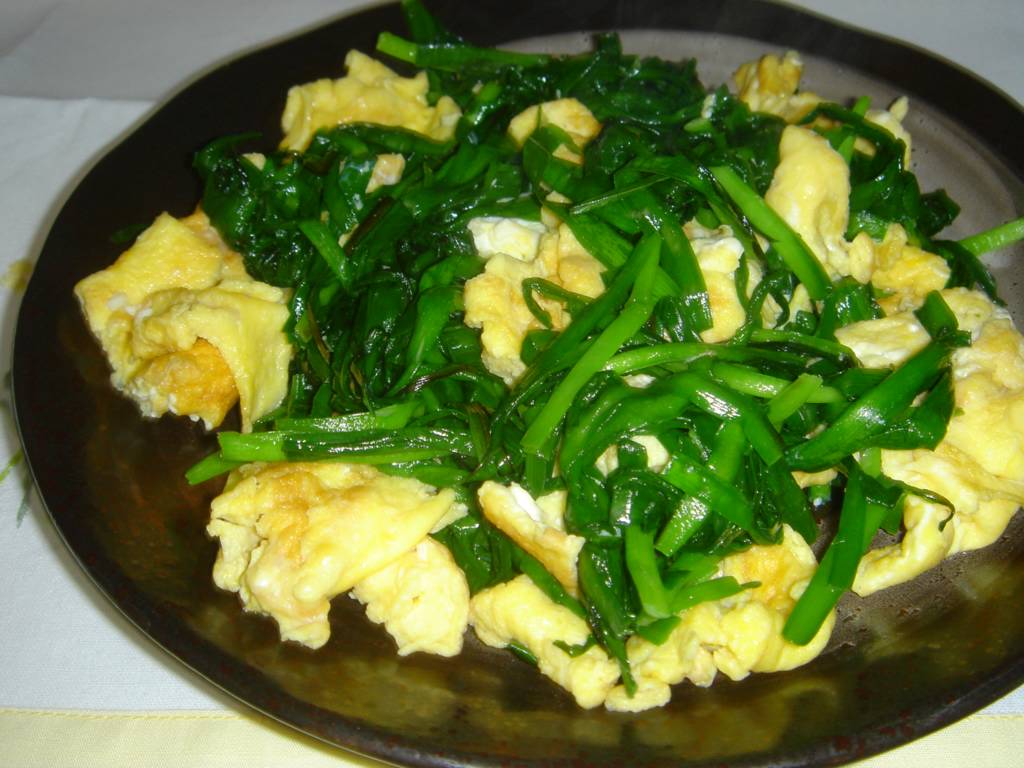
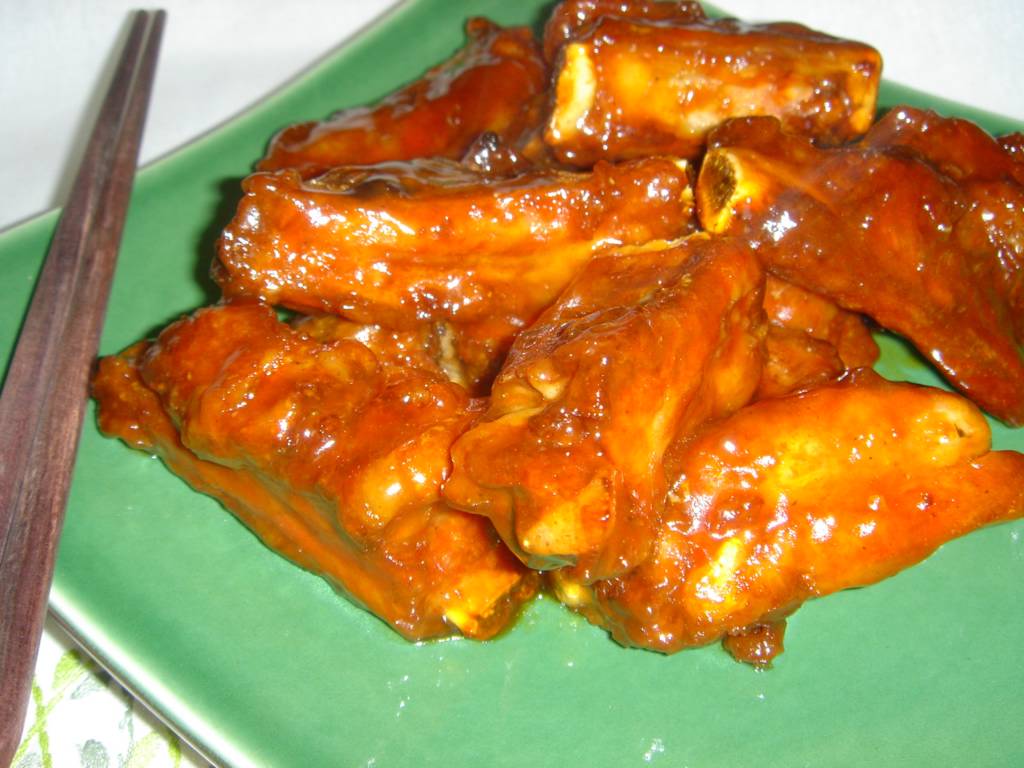
So why would I attempt to make a Chinese dinner? It all started when I went grocery shopping on the day that typhoon #23 made landfall in Japan and saw Chinese chives on sale, 2 bunches for 99yen (a bargain in Tokyo). I thought, I know how to make stir-fried egg and chives. So I bought two bunches. Come Saturday, I realized that stir-fried eggs and chives a meal does not make. I have to come up with a meat dish. Stupid me, who had to ask for my husband’s opinion, to which he gladly offered, “Can you make some tang-cu-xiao-pai (sweet and sour spare ribs)?” Great, he had to pick the one dish with the difficult sauce, which most of the Shanghainese restaurants in Tokyo couldn’t even get right. But he’s worked very hard all week, and just twisted his knee running with our dog, Libby, so I thought I should indulge him a bit. I drew the line, however, when he asked if we could have a soup to go with it. Do I look like iron chef?


So out came the Chinese cookbook that a friend of mine brought back for me from China years ago. Low and behold, there’s the recipe. But wait, under ingredients for sauce, it only listed what’s needed, with no amount whatsoever, like I am supposed to know intuitively how much to add. And to top it off, the spare ribs had to be deep-fried first. Did anyone know this? As if to highlight my inadequacy at making Chinese food, all I have in my kitchen is olive oil, so I had to run to the grocery store again to buy vegetable oil. But I am the proud owner of a tampura frying pot, complete with thermometer to test oil temperature (bought two years ago, and never been used). Why would someone who has never deep-fried anything own a tempura frying pot? Well, I am a firm believer that you first have to have the right instrument before you can make anything.

So after three trips to the grocery store, I am finally ready to cook. Three earthquakes later (richter scale 6.9, 200 some km northwest of Tokyo), and a minor panic over not knowing when the ribs were done, Dinner is Served!


Doesn't look too bad, huh? But as it turned out, I still didn’t fry the ribs long enough to give it the right texture. And I have to confess that I was so discouraged by the vague instructions in the recipe that I cheated and bought a sauce package. Jason’s comment, “No wonder it doesn’t taste right.” Ha, at least now I can blame it on the store-bought sauce.