Friday, January 14, 2005

Apple-A-Day

I love the smell of green apples. Last year, I bought them when Jason mentioned that we should make a conscious effort to eat more fruits, and you know the saying “an apple a day keeps the doctor away.” So I got two bags (a dozen in total). I should have known better.

We have this really nasty and wasteful habit of only eating at the most half of anything we buy before getting bored (very expensive if you know how much food costs in Tokyo). I am constantly throwing out omiyage (food special to a specific region) from our trips, because Jason can never resist any temptation. (I had to juice an entire case of Niigata pears once because he got tired of eating them after just a week and it was too wasteful to just throw them out) Our green apples didn’t fare too much better. We stopped eating them half way through the second bag. For a while, it was nice to just let them sit on my kitchen counter and enjoy the scent, kind of like fresh potpourri. Then the scent went away, and the apples started to wilt, at which point I put them away in the fridge and proceeded to forget all about it. (I am constantly throwing out things in my fridge that I had no idea when I put them in there in the first place.)

When we came back from the States this year, I decided it was time to organize my kitchen, starting with the fridge. Surprise! Green apples from a month ago are still sitting in the vegi drawer looking firm (makes you wonder, doesn’t it?). Normally I would have just tossed them out, but since I sort of made a promise to myself to be more frugal about food this year, I decided we should make use of them.

Since neither of us wanted to eat month-old apples and there were not enough of them to juice, I thought the best way is to use them in baking. I turned to my trusted recipe source: Allrecipes.com and chanced upon a pear bread recipe. Hmmm, apples, pears, what’s the difference, right? (Besides, I don’t see how you can shred pears without ending up with just a big puddle of pear juice.) Some modifications later (to make it healthier), I embarked on my first baking task of the year: making apple bread.

Let me just say that I am glad I didn’t throw the apples out because the bread was deeeelicious and the smell of apples while the bread was baking was heavenly. Here is my version of the recipe:

2 C all-purpose flour
1 C whole-wheat flour
1/4 tsp baking powder
1 tsp baking soda
1 tsp salt
2 tsp ground cinnamon
1/2 C apple sauce
1/4 C vegetable oil
3 eggs, slightly beaten
1 C white sugar
2 C unpeeled shredded apples *
1 C chopped pecans
2 tsp vanilla extract

* apple skin is an excellent source of phytochemicals which have antioxidizing and cancer-fighting properties, not to mention all the fiber it contains.

1. Preheat oven to 375 degree F (190 degree C)
2. Combine flour, baking powder, baking soda, salt, and cinnamon in a large mixing bowl.
3. In a separate bowl, combine the apple sauce, oil, eggs, sugar, and vanilla. Blend well and add to dry ingredients. Stir until just moistened, and fold in the apples and pecans.
4. Coat the inside of two 8x5x3 inch loaf pans with shortening (or butter, or oil), dust with flour. Distribute batter evenly between the two pans.
5. Bake in preheated oven until your kitchen is filled with such wonderful fragrance of apples that you couldn’t possibly wait any longer to taste a slice. (or about 30-40 minutes, but isn’t the smell method much more fun?)
6. Insert a skewer all the way into the thickest part of the bread to check doneness. Bread is ready to come out of the oven if the skewer comes out clean with no wet dough sticking to it.
7. Cool on rack for 10 minutes before removing from the loaf pans.

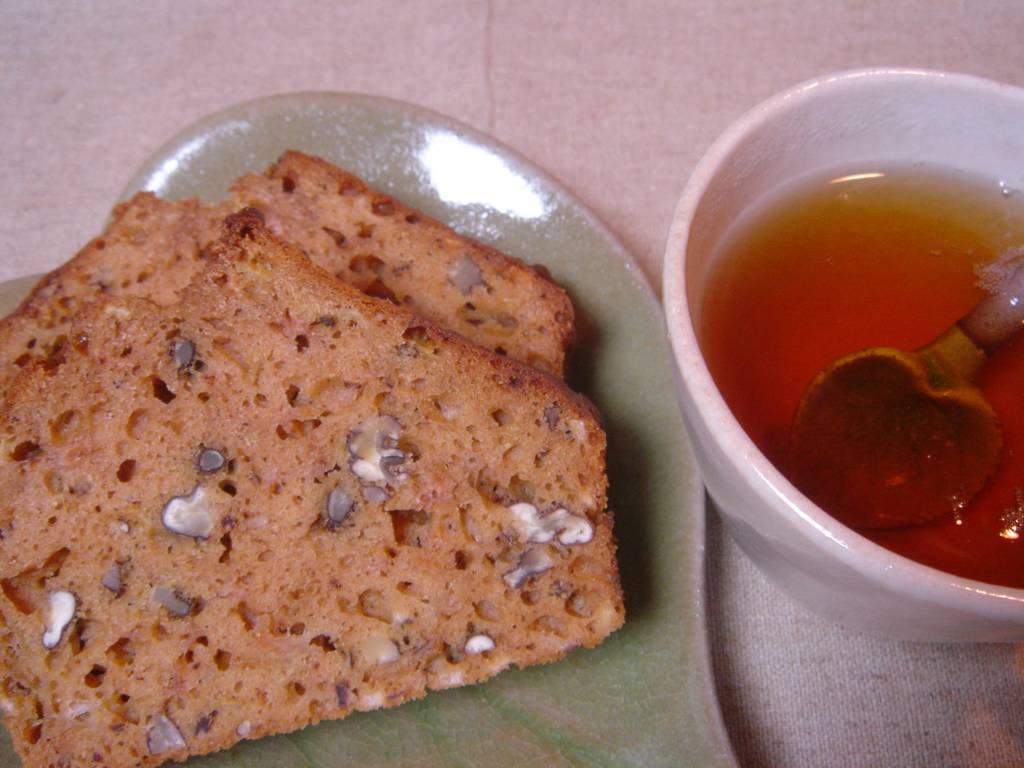
Apple bread, Yay!
TV Cooking Tips #1

Watched one of my favorite Japanese TV shows, ichiman-yen seigatsu (Living on 10,000yen for a month) in between dinner preparation last night. If you are not familiar with this TV show, it usually involves two celebrities competing to see who can live on 10,000yen (about US$100) for a month, including food and utility, in the best style and have the most money left. A large part of the show is devoted to showing how they come up with cheap and innovative menus everyday, which is why I watch. Last night, the show had a special theme: nabe. As a big nabe fan myself, I just had to see what kind of cheap and delicious ways there are to make this excellent one-pot meal.

The participants were Mr. Sanbei (Three Bottles, and I am not kidding) and Ms. Nemoto (Root Origin, no kidding either). Sanbei is my absolute favorite among all the regular participants. He is a TV personnel who graduated from a cooking school and holds a chef’s certificate. He looks like a very huggable Pillsbury doughboy in his chef's outfit and always talks in this slow and soothing tone that just makes you feel warm and fuzzy all over. Nemoto is a former “idol,” an Only-In-Japan breed of celebrity whose only requirement, as far as I can tell, is to look cute. When idols outgrow their cuteness, they often end up on shows like this.

Anyway, I only saw the first half of the show because I had to watch my gnocci sauce, but did get two very helpful pointers, one from each participant.

1. Sanbei made his special chicken stock using a chicken carcass (where can you get that in Tokyo? I’ve never seen one). You know how when you make soup stock there is always that layer of gunk floating on top, and no matter how many times you try to fish it out, you will never get all of it, and the stock ends up looking cloudy? What Sanbei did to obtain a clear stock was putting half a raw egg white into the stock at the very last stage of boiling. The egg white somehow mysteriously pulled all the gunk towards it and solidified them into gunky looking strands that can be easily removed. What you are left with is golden clear chicken stock.

2. Nemoto came up with an original nabe soup stock made of oolong tea. It’s extremely simple. She made a large pot of oolong tea as you normally would, and then threw in half a dried red chili pepper. I suspect that if your taste bud can take some heat, you can increase the amount of chili pepper. Although I was skeptical about this, a food researcher (ryouri kenkyuuka; chef, food critic rolled into one) placed her oolong tea stock ahead of Sanbei’s very delicious looking chicken stock, and said the chili pepper and oolong tea nicely complimented each other. Am still not 100% convinced, but maybe I will give it a try some time.

Thursday, January 13, 2005

A dog's life


Libby finding herself a sunny spot in the living room for a little nap.

Wanna know how a Japanese company works?

I have refrained from writing anything about work, because, well, you just never know who’s going to read it. Granted, I doubt how many people I work with will trawl the internet to pass time, and even if they did, I doubt they’d be interested in any English sites. So I guess I can take a little risk.

Here’s the situation, a faffer who mumbles, who is also a manager, sat on a big pile of unsorted matters, which is actually not all that complicated, but since he let it sit for so long hoping it'll go away, it's about to blow up in his face. At which point he goes to the boss asking for backup. Boss turns to me and another unsuspecting hardworking pawn, basically asking us to clean up the mess, giving us one week to do what faffer was supposed to have finished in the past two months, i.e. writing a quality agreement for a drug company A is making for us. We obligingly agreed to give it a crack, but soon found out that critical information is missing. We went back to boss and faffer and said, “Hey, we can’t write it without knowing how this drug is made.” Faffer who mumbles starts to mumble and this is when it really gets bizarre.

Instead of asking company A to send us the essential information, boss and faffer decides that the other pawn (TOP) and I can wing it and just use information on hand, and whatever we can’t make up, simply leave it blank for company A to fill in later. (All because for some mysterious reason, old faffer promised, probably under heavy influence of Schnapps, that he’d send them a draft agreement before their next meeting, and he was reluctant to go back on his words. It’s a face thing.) We were also informed that we should preferably finish the draft in 3 days so as to send it to company A for review before faffer’s second meeting with company A in Switzerland.

With the 3-day deadline hanging over our heads, TOP and I started to frantically cutting and pasting old information to make a quality agreement out of practically nothing. If you have never seen a quality agreement of a drug before, trust me when I tell you it’s a long (approx. 40 pages) document with a shit load of information that you just can’t grab out of thin air. You need your source information, damn it! Without it, our so-called first draft was a joke.

At this time, TOP and I decided to try one more time to convince our boss that if we sent out the agreement with gaping holes in it, we’d be the laughing stock of the entire pharmaceutical industry. We had a heated 30-minute discussion, involving much mumbling on faffer’s part but my brave fellow pawn and I stood our grounds. The result? I am now in charge of getting the essential information from company A and finishing the quality agreement.

How did that happen? Because I work for a Japanese company, that's how.

Wednesday, January 12, 2005

Passengers Only

One of the reasons we never took any trains to go on skiing day-trips was because I never knew quite what to do with our skis. If we went for more than one day, I could have the skis picked up from my house and shipped to our hotel at the ski resort. But for a day-trip, I couldn’t really have the skis sent to the bottom of the slopes, now could I? So we always drove on day-trips, until we took the shinkansen train to GALA last weekend.

As for the skis? I had a plan. Last year, my astigmatic eyes caused me to mistake a 7-passenger van taxi for a regular sedan. It was spacious and a light bulb immediately came on in my head: there’s space enough for skis in here! I made a mental note to call for one of these if we are ever in need of transporting skis via taxi.

Smug with my foresight, I looked up Nihon Koutsu, the company that has a fleet of those vans, on Yahoo Japan. Lucky me, they even have an English speaking line. As I packed our ski bags, I asked Jason to book a taxi to drive us to Tokyo station. First, we were shocked to learn that they charge 1000yen extra for advanced booking: 600yen for booking and 400yen for pick up. (That’s the price to pay for being lazy.) I gave Jason the OK to book it. Then he felt the need to explain to the operator why we needed a van for only two passengers, and things went south from there.

At first I heard Jason struggling to make the operator girl understand that we are going skiing and need a car big enough for our skis. Judging from Jason’s reactions, she must have said no-can’t-do. Fearing that she might have misunderstood him and thought we were taking the taxi all the way to the ski resort, I told Jason to tell her we were only going to Tokyo Station. That didn’t work either, and Jason said they didn’t have any cars big enough for skis. What do you mean they don’t have any? Do I have to get on the phone myself even when it’s an English line?

Me – “You have vans, big cars, right? I saw them on your website and have taken it myself.”
Girl – “Yes, we do, but skis will not fit in them.”
Me – “What do you mean they won’t fit? There are only two of us, the rest of the space will be empty.”
Girl – “ Yes, but the seats are for passengers.”
Me (getting more and more exacerbated) – “But like I told you, there are ONLY two passengers. There will be PLENTY of space left in the van. Don’t people with lots of luggage use those vans to go to the airport?”
Girl – “No, we do not allow luggage in the van.”
Me (silently, what the #%&$?) – “ You do not ALLOW luggage in the van?”
Girl – “Our vans are for passengers only, and if you want to put luggage in the van, we’d have to convert passenger space into luggage space, and we cannot do that.”
Me (again silently, who the #%&$ asked you to convert the #%&$ van?!) – “ But I am not asking you to convert your van, we just want to put our skis into the van, surely it will fit.”
Girl – “Only passengers are allowed in the vans…”

At this point my patience ran out and I didn’t bother to find out what other nonsense was spewing out of her mouth. Man! You think that after four and a half years in Japan you’ve seen all the malicious side effects of an entire nation of people with inflexible/can’t think for self/droid-like mentality, then you get hit with “Sorry, our vans are for passengers only.” What do you say to that?!

Jason suggested that I call back to the Japanese line and try again, but no, I would not give my business to a company that a) has a stupid rigid policy like that, b) trains their operators to give answers from a script, c) charges an extra 1000yen just for booking! In fact, I will never ever get into a Nihon Koutsu taxi, EVER!
We ended up hauling our skis to the station ourselves, but the 7-minute walk to Gaienmae station was surprisingly painless, and the train to Tokyo station was practically empty. So what if we got to our shinkansen a little out of breath? Just think of it as a warm-up. Plus, the satisfaction to have one-upped Nihon Koutsu was priceless, even though they don’t know it. HA!

Tuesday, January 11, 2005

Doggie Pillow


Libby was fluffy and soft after a bath, so Jason decided to use her as a pillow.

First Ski 2005

For every ski season, there is a “first ski” (hatsu-suberi in Japanese). It usually means the first weekend that a ski resort opens for the season, but it also means the first time one goes skiing for the season.

For our first-ski this year, we took the JR day-trip package to GALA Yuzawa. 13500yen per person gets you a return-trip shinkansen (bullet train) ticket, plus a one-day ski lift pass worth 4500yen. Considering how much we would’ve paid in highway tolls, plus gas, it’s not a bad deal at all.

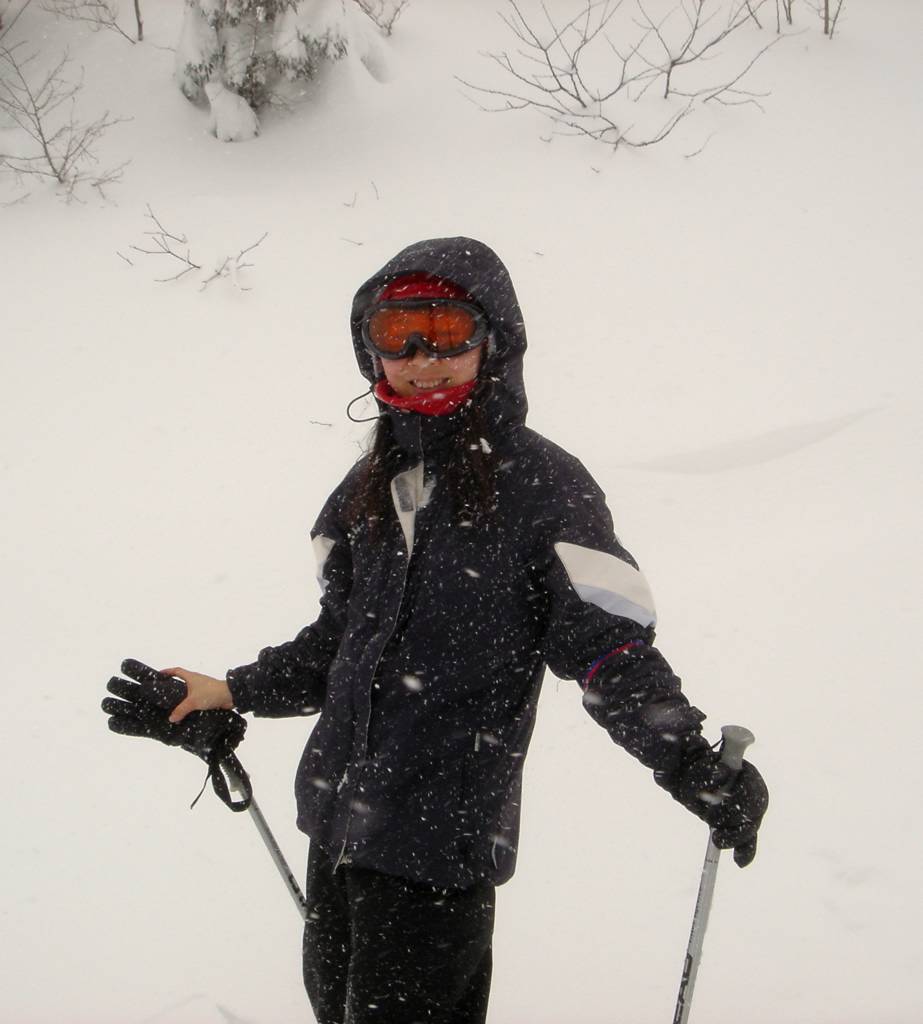
The train ride took a little over an hour and a half. All along the way, there was no snow in sight. Then the train went into a tunnel, and when we came out on the other end, it was like a different world. I stared and said, “But, but, it was sunny just a minute ago.” Feathery snowflakes engulfed our train as it pulled into the station. GALA Yuzawa ski resort is directly connected to the shinkansen station: you step off the train, go up one floor, and you are in the lobby of the ski resort’s main building. It’s so convenient, I don’t know why we never came here instead of insisting on getting up at 4am and drive to ski resorts.

Half an hour later, changed and our things stored away in the locker, we were ready to hit the slopes. I was extra glad that I took precaution and brought mini heating pads (the type activated by body heat). I had one in each ski boot, one stuck on my tummy, and another one slipped into the kangaroo pouch on my fleece pullover.


“I am ready!” said I to the snowflakes coming straight into my face.
And I was glad to find out that, unlike last year, my skiing muscles didn’t refuse to wake up after a one-year hibernation. But it was cooooold! I covered myself up as much as possible, but the few patches of exposed skin on my face still felt the freezing wind and a stray strand of hair quickly became an icicle hanging next to my face, grrrrrrr!

I guess this is the price to pay for the adrenaline rush and the fresh mountain air. Let the ski season begin!

Friday, January 07, 2005

A Somber New Year

2005 began with a somber tone. The tsunami that hit South Asia and parts of Africa during last year’s Christmas season still rings fresh in everyone’s mind. I admit I had been immersed in my own little world of cooking for my parents and keeping my dad company, as well as shopping the sales for the past two weeks. Of course I knew about the tsunami, and read it on CNN’s website, but maybe it was because I didn’t watch any TV at my parents’ place, it didn’t hit me until yesterday as to the extent of damage and casualties those areas suffered.

Yesterday, a day after coming back to Japan, I turned on the TV for the first time and tuned into CNN to see Soladad O’Brian reporting live from Phuket. The TV screen is filled with corpses wrapped in white or blue sheets and secured with duct tape. Workers with facemasks sprayed giant open-air morgues with what I assume to be anti-infectants while flies swarmed around, and volunteers worked to obtain dental record or fingerprints for identification purposes.

Sitting there watching, I thought about how it could’ve easily been us. We love Phuket’s pristine white sandy beaches and have visited twice while living in Singapore; and Maldives, paradise on earth, is where we spent ten blissful days in May of 2003. I logged onto the website of Soneva Gili, the resort we stayed in Maldives, and found it closed due to tsunami damages. Luckily, all guests and hotel staff were unharmed but some staff lost family and homes on other atolls. My thoughts couldn’t help but turn to Mo, our Guest Relationship Officer with the bubbly personality who took care of us 24-7 while we stayed on Soneva Gili. I hope he and his family are ok. One of Jason’s colleagues was in Sri Lanka with his wife and two young children when the wall of water came crashing in. They climbed to the top of the hotel building and prayed for the water to not rise any further. Lucky for them, it didn't.

For every survival story there are thousands who were not so lucky, and the long-term economical and ecological effects in the area is hard to estimate. With disasters of this scale, one of the immediate priorities is to prevent outbreaks of deadly diseases such as cholera and dengue fever, achievable in part by ensuring clean drinking water and other basic hygiene standards. WHO is calling for 66 million USD in donation to help combat disease outbreaks. Here is an example of what your money can do, according to WHO:

US$10 ensures…
…that one person has access to safe drinking water for four days. Individuals must have access to 10 litres of safe drinking water per day, to reduce the risk of waterborne diseases, particularly the onset of various diarrhoeal diseases such as cholera.

US$50 ensures…
…that 70 people have access to basic medical care for a period of three months. Populations living in overcrowded temporary shelter accommodations are at increased risk of disease and will require an increase in medical attention.

US$100 ensures…
…that 10 people can be treated fully for diarrhoeal diseases (including cholera). Diarrhoeal diseases are a major cause of mortality among populations who may not have access to basic human needs.

US$150 ensures…
…that full surgical care is available to one person. Following catastrophes, it is estimated that approximately one percent of the population requires access to full surgical care. An additional ten percent of the population will require care for minor trauma and injuries.

Donation is easy, just click here.